
New Publication on Fabrication-Aware Structural Optimisation for 3D Concrete Printing
A new AM2PM publication from researchers at Technion – Israel Institute of Technology explores how fabrication requirements can be incorporated directly into structural optimisation for 3D concrete printing. In the paper An integrated computational framework for structural optimization of prestressed concrete structures with 3D-printed formwork, Emad Shakur and Oded Amir present a unified approach combining structural design, prestressing, toolpath geometry and fabrication considerations.
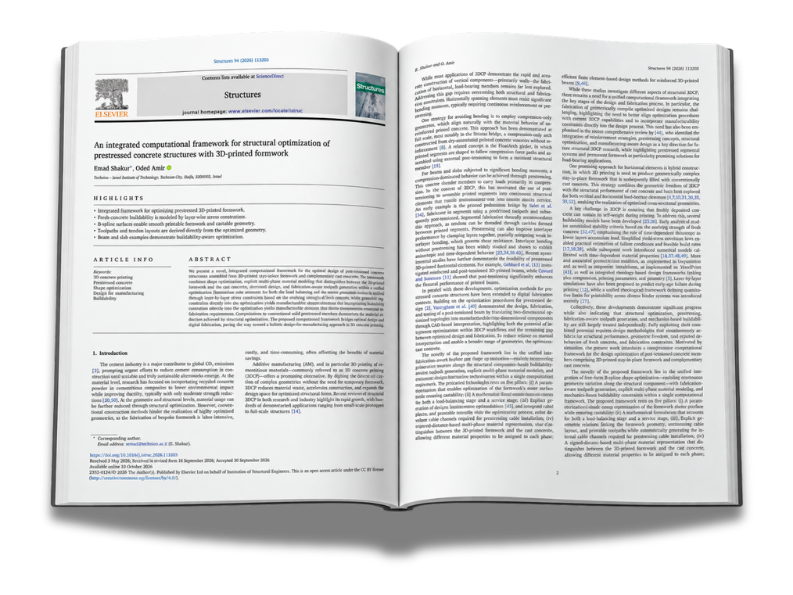
The framework focuses on post-tensioned concrete structures combining 3D-printed stay-in-place formwork with conventionally cast concrete. To ensure that optimised designs can also be manufactured, it evaluates the buildability of fresh concrete layer by layer and generates smooth, continuous and printable toolpaths with dedicated channels for prestressing cables.
Numerical beam and slab examples show that the approach can produce structurally efficient, print-ready designs while reducing material use. Compared with equivalent solid prestressed members, the optimised designs reduced concrete volume by 41.30% for the beam and 32.29% for the slab.
The work contributes to AM2PM’s development of more predictive and fabrication-aware approaches to 3D concrete printing, bringing structural optimisation closer to the realities of manufacturing.
The full publication is also available on Zenodo.